Hello, again! Wow, so far this year has been a busy one for Gail Barley Interiors. In addition to many decorating projects with some great clients and interesting spaces, here’s a quick update to let you know what we've been doing.

Gail Barley Interiors was a featured designer on Wayfair.com in their Inspiration Gallery. I was asked all kinds of questions about my design process. I was honored to be featured on this nation-wide site.  If you would like to see the article, here is the link: www.wayfair.com.

Another exciting moment for me was when Houzz, a popular decorating and home website, gave me the Best of Houzz 2014 Award in Customer Satisfaction. Here’s a little bit about what that means as described by Houzz: “Chosen by the more than 16 million monthly users that comprise the Houzz community,” Gail Barley Interiors was awarded, The Best Of Houzz. “Customer Satisfaction honors are determined by a variety of factors, including the number and quality of client reviews a professional received in 2013."  If you would like to check it out, feel free to click the link: www.houzz.com.

Late in March was the American Fuel & Petrochemical Manufacturers Annual Meeting. The meeting was attended by 1400 people and, as the AFPM website describes, it is "the world's premier refining meeting, assembling key executives, decision-makers, and technical experts from refining businesses, technology providers, contracting and consulting firms, and equipment manufacturers around the world". I know this doesn’t sound like it has anything to do with decorating but I was chosen as a speaker for the Spousal Event on the first day of the three day convention. I spoke to this group about how to use color in your home instead of falling back on "safe", neutral colors. In my seminar titled, “Beyond Beige” we discussed how to decorate with color to give your home personality and to make a home a personal reflection of the people who live there. After the powerpoint presentation, there was a Q & A time followed by a hands on session where participants used fabric swatches, wallpaper samples and paint chips to create an inspiration page for their own homes. Each participant left with a custom journal, created and designed by Gail Barley Interiors, to help her on her way to designing her own home, hopefully, without defaulting to beige! It was a wonderful time and I met some amazing women.

Suffice it to say it’s been a busy winter, not that I’m complaining!
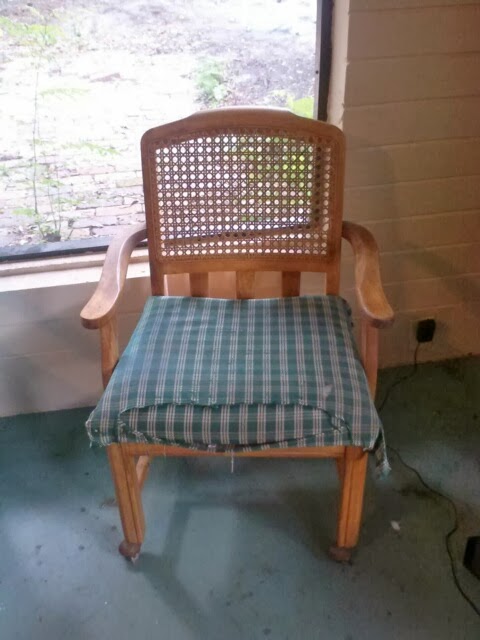


Before
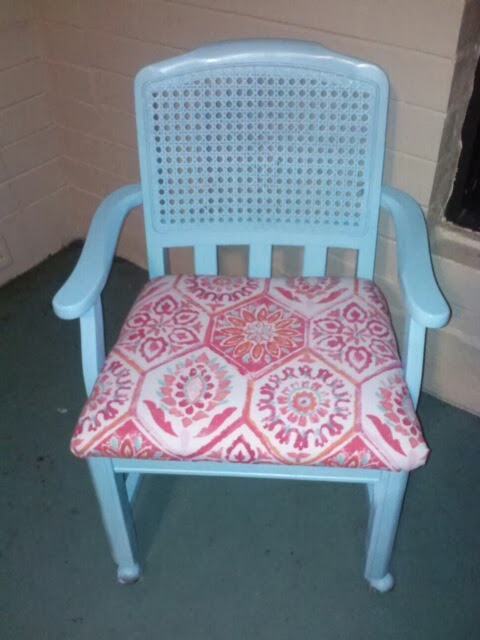
   Upon moving into her new rental space, my daughter found that turning a house into a home takes a considerable amount of work. As she was moving into her house she spotted some kitchen chairs on the side of the road and having a very small furniture budget and knowing potential, she picked them up. These four little chairs had seen better days, wooden, with an outdated finish, and hideous, worn, green plaid upholstery, they had been left for dead. The following weekend she started the process of bringing these chairs back to life. With some decorating-mother tips, she was able to do just that. We went online and found some sale fabric with a cute, hip design. For $30 she had enough fabric to reupholster the chairs herself. 

Fabric from Greenhouse Fabrics
   With a fabric sample in hand she ran out to the local hardware store and quickly snatched up an entire inventory’s worth of light blue spray paint, the perfect match to the accent color in the pattern we had chosen. Armed with a spray can and a face mask, she worked diligently in the backyard on a Saturday afternoon and turned the chairs from pine-y brown into a bright and fun aqua. With step one a success, she took her fabric, staple gun, and new batting and set out to recover her chairs with our new fabric choice. Two busy days later, she had her end result: a set of chairs that matched her home and personality while providing plenty of space for her friends to sit while chatting and playing ping pong on the back porch.

After
    Sometimes the answer to "should I leave that in the garbage" is an easy and obvious "yes", and sometimes it takes some discernment. My advice, if you have a place for it, you have the skills to bring it back to life, and you have the time, then grab that "trash" in a hot second. But if you don't answer yes to all of these, it really is garbage so leave it for the trash collector.


Most of the clients who contact me have never worked with a decorator before and don't know what to expect from me or the process.  Assuming that you have chosen wisely, and you and your decorator have a good understanding and vision for your space, here are three easy steps to ensure a productive and mutually satisfying design partnership:

1.  Be Decisive.  This is the single most important factor in whether or not your design process runs smoothly and proceeds in a timely manner.  As a decorator, I can't do anything without first getting your approval.  For everything from budgeting to window treatments to delivery times,  I need your input.   I can recommend many things but unless you can pick one and not vacillate, nothing gets accomplished.

2.  Be Honest. If you don't like the things your decorator is doing or the direction the project is going, say so!  If you hate every one of the five chairs you were shown make that clear. But don't stop there, explain what you don't like.  Is it the color, the style, the price?  If you don't make your objections clear you are likely to get more of the same.  Having said that, the choices your decorator makes are not random.  Tell your decorator your concerns and then give her the chance to explain why she made her choices.  The decorator is looking at the big picture and how all the elements of a room come together.  She should be able to articulate the reasons for her choices.


3.  Trust me!  By saying "trust me", I am really saying trust yourself.  You chose your decorator because you like her work and have a good rapport.  Have faith that what she is recommending and suggesting has been thoughtfully and professionally done. Trust that there has been consideration given to budget, personal preferences, timeline and overall outcome. This doesn't mean hand over the keys and the check book and go on vacation. It does mean that you don't question every decision and ask for justification of every choice.  After all, people hire decorators to do what they can't or won't do themselves.  You have to trust in your decorator's talent, knowledge and experience.  If you don't trust your decorator, terminate the relationship and find another decorator.

For me, the best jobs are those that deliver a product that my client is thrilled with, but the most satisfying jobs are those that run smoothly, stay on budget, and result in a good design.

Now that you have these guidelines, call a decorator and get started on your dream home!


I am changing my usual blog format today because I want to talk about Thanksgiving.  I recently read an editor's page in a shelter magazine about the editor's experience hosting Thanksgiving dinner.  She noted that in the past she tried going all out: silver, crystal, china, fresh flowers, real linens, and it was just too much work.  As a result, she says from now on it is paper plates and napkins for her.  This depresses me! I know many of us don't have the option to pull out the family silver, the wedding china and the linen tablecloth because we aren't lucky enough to have them.  As one of the lucky ones, I ALWAYS host my family for Thanksgiving dinner and I always use the "good stuff" I am fortunate to have.

Thanksgiving is my favorite holiday celebration.  Yes, you can argue that there are other holidays that are more important and I don't disagree, but I love Thanksgiving.  The reasons are simple, turkey day is all about being with family and friends, sharing good food and expressing gratitude for all the many blessings we have.  I love having one day a year that is focused on gratitude and in my house, the Thanksgiving prayer is just as important as the turkey.

Thanksgiving Past
I spend much of Thanksgiving week, preparing for the big event.  Monday, I do the grocery shopping and polish the silver pieces I intend to use.  Tuesday, I plan seating charts, set up extra tables as needed and move out furniture that may be in the way if I am having a large group.  (In a good year, I host 25 - 30 family members and friends).  I also plan each table setting. Wednesday is a big day.   I bake the pies from scratch, purchase flowers at the local wholesaler and put them in vases to condition them. I put the linens on the table, doing last minute touch ups with the iron. I set the tables and place serving pieces on the buffet.  On Thanksgiving day,  I arrange the flowers, prep the turkey and peel the potatoes early in the day.  Because we have dinner around 6:00 p.m. I have all afternoon to cook.  My one concession to the amount of work a huge dinner takes and to the limitations of my kitchen is that many of my guests bring side dishes to share. I am responsible for the turkey and stuffing, mashed potatoes and gravy, rolls, and the aforementioned pies. (I know it would be easy to have someone else bake the pies, but I LOVE pumpkin pie and to me having a good pie is just as important as a good turkey.) After the main event, someone usually offers to help clean up.  Yes, by then I am pretty tired, but it is a good tired.  The leftovers are put away, the silver, china and crystal get hand-washed and the dishwasher loaded.  Once the dishwasher is full, I call it a night and go to bed. Friday is clean up day and the table linens are washed as well as any dishes left from the night before.  The silver, china and crystal are put away and the furniture set to rights. (I will admit that I don't feel at all guilty if I spend most of the weekend on the couch!)

Reading this list, even I am somewhat overwhelmed by how much work it is!  Why do I do it?  Why do I look forward to doing it? The answer is simple.  I want everyone who shares this meal with me to feel special, welcome and appreciated.  Giving the ones I love those few hours at the table with family and friends, sharing a good meal at a table set with beautiful things (many of them family heirlooms) is my way of saying I am thankful for each one of them.  I do all this because I love them and they are worth it.

Wishing you many things to be grateful for this Thanksgiving.


I feel obligated to call out my fellow designers and decorators. I’ve noticed a trend in decorating that really bothers me. If you read the shelter magazines regularly, you’ll notice that room after room features all white upholstery.

Really? Who lives like that?

When asked about the practicality of this, the designer will typically say things like: it is a slipcover, easily removed and washed; the fabric has been treated with a stain protector; it’s an indoor/outdoor fabric and is easy to clean.

But is there anyone who has so little to do that they want to give more of their precious time to cleaning and laundering the upholstery? My responses to the above explanations are: removing, laundering and replacing slipcovers is hard and time consuming; stain protector or not, a guest sitting and drinking something like red wine is still going to make you nervous; indoor/outdoor fabrics are great but even they get dirty and require cleaning.


I guess the reason this trend bothers me so much is that I want to design rooms that people actually live in and enjoy. In most houses, it is just not practical to have something in a space that you’ll constantly need to worry about. That includes a rug that is easily stained, upholstery that is difficult to clean, and surfaces that are easily marred. When I was growing up, many families had rooms that were pretty much off limits to children and pets. People just don't live like that any more. Real estate in a house is generally too valuable to devote space to rooms that are rarely used.

Yes, all that white can look lovely when the room is first finished, staged and photographed. Let's see the same room a year later after it has been lived in!  I seriously doubt it will be so pristine. Come on designers, there are so many beautiful upholstery fabrics that work better for real families than white, no matter how much we tell ourselves that it is easy to clean!


A LITTLE FLUFF. . . 

My daughter and I have been having fun decorating the little house she is renting. The first order of business was paint. The landlord painted every room in the house beige with pink undertones. Although many people think "beige goes with everything", this beige didn't look good with any of the brightly colored furnishings we wanted to use. Fortunately, the landlord was willing to let us repaint with any color we chose. I have a lot of experience with painting, so the only cost was for paint. For about $35 dollars per space, we were able to make big changes. The changes in wall color made a huge difference in how her things looked in the house and how she felt in her rooms. Now, the spaces look young and fresh. Just right for a couple of girls out of college and just testing their wings. 


How about turquoise?
 More pictures to follow


I want to encourage all of you renters out there to paint your spaces if possible.  We may have to repaint when my daughter moves out but she really wants to enjoy this house and make it her home.

Money well spent.


Picking a decorator is like picking a spouse — you want someone who shares your vision, someone you have rapport with and someone who is strong in places where you may be weak. Decorating is a personal business. You want to find someone who will compliment your lifestyle and bring out the best in you. So I thought I would use this blog to discuss the best way to find and interview your own decorator.

First, there’s finding a decorator. Websites like Houzz and Google are good places to start if you don’t know of any decorators, but often referrals can be the best way to find what you’re looking for. Realtors, builders and contractors often work with decorators, so don’t be afraid to ask for their opinions and suggestions. Designers also often have websites, so once you find or hear of someone you might be interested in, search for them online and you’ll most likely be able to find their professional information and portfolio.  Looking through a decorator’s portfolio is an easy way to tell if your style will match their designs.  

Friends have also asked me what credentials they should look for when hiring a decorator. How many letters should decorators have behind their name, and which are the most important letters to have? Decorators and designers can have several different certifications, such as ASID (American Society of Interior Design), IDA (Interior Design Accreditation), CID (Certified Interior Decorators), and DSA (Designer Society of America). These are jus a few of the many designations a designer may have. My best advice is that while credentials are important, a strong rapport with your decorator is more valuable than the letters behind their name. Design is personal (I know I keep saying that, but it’s important to remember!), so while credentials can give you assurances that a designer is qualified, don’t let credentials be the deciding factor.

While you’re interviewing your decorator, there are things you have to remember to ask. It’s important to ask how much a decorator charges, and if that charge is an hourly or flat rate. You’ll need to know who will make the purchases, and how they will be paid for. Decide on a budget and tell it to   your decorator. Make it clear how much you’re willing to spend so you and your decorator can make a realistic plan for your house. The main idea is to keep an open communication with your decorator. Let them know what you think of their ideas, and don’t be afraid to disagree with their plans. If you feel like your decorator's feelings will get hurt if you tell them you don't like some aspect of their design, move on. It’s your project, and you have to be comfortable voicing disagreements as well as praise. That said, be open to new ideas and going a little outside of your comfort zone.  Give the decorator room to be creative.


Finding a good decorator can create a relationship that lasts for years. Whether you’re designing in stages, or doing one massive renovation, design is personal (am I making my point?) and your decorator will be very much in your personal business. It’s important to trust him or her with your plans. This is a creative business, so make sure you’ve picked a decorator that’s the right partner for you.  Do your homework and you won't end up divorcing your decorator!


A LITTLE FLUFF. . . 

I have started a new project that I will be sharing with you, step by step.  After finishing college and finding a job, my daughter's next step toward independence was renting a house.  Lucky for me, a small house across the street was recently converted to a rental property.  This used to be, by far, the worst house in the neighborhood.  A 1950's house with 2 bedrooms and 1 bath, its charm was masked by overgrown shrubbery and peeling paint. The inside was even worse.  Recently, a neighbor purchased the house and spent considerable time and effort to make the house habitable and to uncover its classic 50's appeal.  The stars aligned and the house became available just as my daughter was looking to spread her wings.  She found a college friend who had also recently found a job in the area to be her roommate so she signed a lease and moved in.  I will be sharing with you the process that we are undertaking to make this little house a home on a limited budget.  Admittedly, having a decorator for a mother is an advantage that most new home owners/renters don't have but I think there are things that all of you can learn from this process.
The Exterior Receiving New Paint

I've enjoyed poking around antique stores since I was an eighteen year-old college student. I’m always excited by the idea of what I might find, whether it’s something I’ve been searching for, or something completely unexpected. I’ve found some of my favorite art, furniture, and accessories from the different shops I’ve visited. I’ve even taught my daughter and her friends the fun of antique shopping (and I think they actually like it and are not just humoring me).

For those of you who haven’t spent time in second hand shops you might be surprised by what you can uncover. Antique stores, thrift shops, and second hand boutiques can contain real bargains and hidden treasures and the anticipation of discovery is part of the fun. You never know when you will find a great deal or something unique . Most of my furnishings and accessories have either been hand-me-downs (I had a Grandmother with fabulous taste and the means to buy quality) or "previously owned".  Even now when I have access to thousands of new products, I still like to try to keep or add something with a past to every room I decorate.
Some of my finds: A french chair, a  vintage desk
 with a leather top, an antique iron lamp.  Even the buttons
on the chair's slipcover are recycled.
While there are many retail companies that make well styled and well priced products, they sell to the masses, so you may see your sofa, lamp, curtains, etc. in your neighbors' houses. If you want your home to have individuality you have to spend a little time and effort to find things that aren't mass produced (at least not any more). 

Lots of decorators know the benefits of second hand shopping. One of my favorite designers is Sarah Richardson, you may have seen her on HGTV, she often buys things second hand for her design projects, even if that means rescuing furniture off of the curb. (Something I’ve done myself.) These reclaimed pieces are part of what makes Sarah's signature look. There can be great finds in second hand stores, but be careful, good bargains can be found but it does take a good eye to recognize a diamond in the rough and a little knowledge to know an original from a reproduction.

Second hand shopping is all about finding things of value in unlikely places. Once I found a signed, first U.S. edition of Daphne du Maurier's, Rebecca, one of my favorite books, for $8! I found a large French etching in a cheap frame, covered in dust for $65. I have a pair of italian chairs with down cushions I purchased at a neighborhood antique show years ago. I paid $250 for the pair and they now sit in my living room. One of my favorite pieces is a simple mahogany tea caddy I paid $100 for the last time I visited my grandmother in upper New York state and we went antiquing in Rhinebeck. I could go on and on but you get the point. I don't always find something wonderful when I go shopping and neither will you, but I almost always come home with something I didn't even know I wanted. 


A LITTLE FLUFF. . . .

I feel like I must make a confession.  In my second blog, I shared with my readers about my secret lamp addiction.  Well, recently I fell off the wagon. It wasn't my fault. My mother and sister suggested we go poke around a few shops after a recent lunch together. They are clearly enablers.

First, I talked my mother into buying an awesome vintage wrought iron light fixture for the living room in her adorable craftsman cottage. In my defense, she did love it and the inexpensive fixture she had in the house didn't do the room justice and this one was ON SALE!! 

Just as I thought I was going to escape unscathed, I spotted it.  Sitting on top of a six foot tall book shelf with a totally unworthy shade, was a Murano glass, gilt wood and iron lamp. I started to breathe a little faster, my heart started pounding, I heard music playing (but that could have been the store's sound system).  Why was I so excited?  Well, Murano glass is some of the finest glass in the world and even at wholesale prices, Murano glass lamps aren't cheap. This one was marked $235. I think my mother and sister were a little skeptical when I started gushing about how fabulous it was but all that time in dusty shops and hours spent reading design magazines and surfing the web told me it was something special.  I asked the shop keeper if he could "do a little better on the price"  even though it was already a bargain at $235. I ended up leaving the shop with my dusty lamp with it's too tall shade for $200.  When I got home I did a little research.  I found the same lamp for sale on Ebay for $1,200 and a similar lamp that had recently sold on 1st Dibs (a website for high end antiques).  

Of course, I have no place to put it yet and I need to buy the right shade but I still feel an adrenaline rush every time I look at it.  Being a Lampaholic is a struggle.  Pray for me.